


RETSINA
- Home
- RETSINA
ΗISTORICAL ΡESEARCH
Viticulture appeared for the first time during the Neolithic period and is the result of the appearance of the first cultivation efforts and the domestication of the first plants, combined with the invention of the first ceramics, which were the containers for winemaking. According to the data known so far, the first vinifications took place in the South Caucasus region and from there the techniques and process for winemaking spread to the Mediterranean basin.
The first recorded traces of wine were discovered inside amphorae in the Haji Firuz region of present-day Iran, on the Zagros Mountain range. This finding, which dates to 5400-5000 BC, shows that, already at that early period, wine had been integrated into the economic, social and religious fabric of humanity -something that we certainly take for granted today. The impressive thing about this finding is that it contains traces of resin, which means that the oldest recorded sample of wine in history is basically a resinated wine (retinite).
Ancient times
Regarding the Greek area, the first samples of resinated wine appear in Crete, specifically in large jars discovered at the site of Fournou Korifi, in the area of Myrtos (2200 BC).
Apparently, at that time resinated wine traveled to Greece from the Eastern Mediterranean, as resins and resinated wines had been produced and traded in the Aegean and other parts of the Eastern Mediterranean from hubs in Syria and Palestine much earlier.
During this period, resinated wines were considered luxury goods and were traded internationally for consumption by the elites of the Eastern Mediterranean.
During antiquity, resinated wines were traded throughout the Mediterranean and produced locally in many areas of southern France and northern Italy.
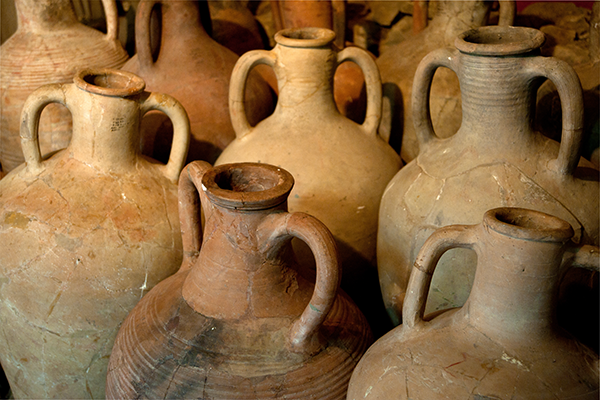
Resinated wine production was gradually limited to the Greek area. When the Romans conquered Gaul, they adopted the use of the wooden barrels from the Celtic tribes of the region. The replacement of ceramic containers for the storage and transport of wine was made for reasons of convenience – as wooden containers are lighter – and not for reasons of quality. Moreover, the use of wooden barrels in winemaking has been known since long ago, while traces of this use have already been identified in the Bronze Age.
Gradually, the Roman aristocracy turned to Italian wines, while at the same time the fine wines of the Aegean were discredited. It is characteristic that during the Imperial Period, aristocrats in Greek cities served wine exclusively from Italy to their tables of guests.
The resinated wine of the Aegean naturally followed the course of all Greek wines. As the elites shifted, the resinated wine lost its glamour, becoming geographically limited, locally produced and therefore a folk wine.
Byzantine era
With these data, resinated wine continued its journey entering the Byzantine period.
For the period that extends from the 5th century AD until the creation of the new Greek state, in 1830, the source of the information is mainly reports of travelers and visitors of the Byzantine Empire and then of the Greek area under Ottoman occupation, as well as tax records of Ottoman administration.

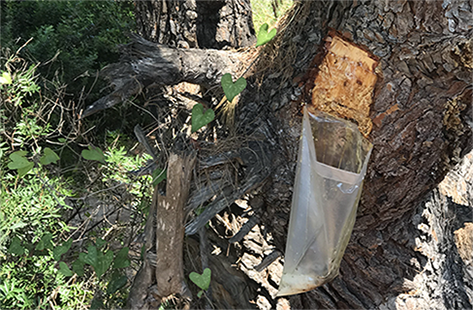
Beside the traditional areas of production and consumption of retinite around the Aegean, new areas appeared around Constantinople, as the capital of the Empire became the center of consumption of wine in general and particularly retinite.
However, quality excellence was found in wines such as Moschatos or Monemvasios (Malvazia), old Nicaenos or the despotic wine of Bithynia, as well as wines from the Aegean islands, Crete and the Peloponnese -mainly sweet. Retinite was, basically, a folk, low-quality wine that was consumed fresh.
During this period, the practice of using second-quality wines to produce retinite had already begun, while the problems that those wines presented were treated by adding a high amount of resin.
The result was a wine with a peculiar character, which appealed to those who were used to it, but alienates or even repelled the Westerners.
The negative image that the retinite had built led to a new geographical restriction. Especially after the fall of Constantinople, whose lower income groups were among its main consumers, resinite ceased to be an object of extensive trade and was limited to wine for local consumption. In any case, the limited sources of this era and the references to wine and winemaking, let alone resinite, cast a veil of mystery around the production and consumption of this type of wine. We will meet it again after the liberation, when Athens, historical center of retinite production, became the capital of the modern Greek state.
Modern Greece
In 1830, when Athens became the capital of the newly formed Greek state, along with the increase in population, but also in economic activity, the production and consumption of wine, i.e., the production and consumption of retsina, flourished.
The vineyards from the large farms of the Mesogia, which were created when the Turks left the area, were gradually added to the vineyards of the capital, in Ampelokipous, Patisia and Liosia.
Retsina was so widespread and loved that for the first time we find references to it in prose, poetry, song or in press reports. In this period, retsina continued to be a folk drink, as the aristocracy chose the fine wines from the Aegean islands, while foreign visitors from abroad who were not used to it continued to reject it.
After many centuries, a good moment for retsina came from the cooperation of the wine merchants of Athens with professional oenologists in the 1920s, which resulted in the improvement of the quality of the wine. As a result of its quality upgrade, retsina, which until that moment was consumed exclusively in the pubs and taverns of Plaka and Psirri, gradually made its appearance in the fine dining restaurants of Athens.
Another good moment and a step towards the quality upgrade not only of retsina, but also of Greek wine in general, came in 1926, the year in which the first Legislative Decree regulating wine production was issued. In this same Legislative Decree, there was also the first reference to the addition of resin to wine.
After the end of the Second World War and with the rapid economic development that the country has been experiencing since the 1950s, the first developments in the production of retsina were also noted. More specifically, at the end of this decade, the first bottlings of retsina took place, first in Alexandroupoli (Adamidis) and then in Chalkida (Malamatinas) and Mesogeia (Kourtakis). The new era for retsina held enormous growth opportunities, but it also carried risks. Bottled retsina was ready to travel again within and beyond borders, leaving behind the centuries that it was a product of regional production and local consumption.In this context, the bilateral agreement signed with Germany in 1966 for the protection of retsina as a Greek product (along with retsina, ouzo and Corinthian raisins received the same protection status) was another important milestone in the history of this wine.
After the painful hiatus of the seven-year dictatorship, Greece’s accession process to the European Community was starting again.
In this context, and for retsina to be included in the Community regulations for the wine sector, in 1979 the first Presidential Decree was issued exclusively regulating the production of retsina.
Gradually, however, retsina left the table of the Athenians, since they showed an increasing preference for the new wines of Greek producers, as well as imported ones.
In the same period, on the contrary, Thessaloniki continued to drink retsina, mainly bottled. Gradually this city and Northern Greece in general became the center of the consumption of bottled retsina. Nowadays, even the retsina produced in the units of the Malamatina company in Ritsona and Avlida is bottled in Kalochori, Thessaloniki. It is significant that according to data from the Greek Ministry of Rural Development and Food for 2018, the production of retsina in the region of Attica was much smaller than the production in the region of Thessaloniki.
At the same time, while the consumption of retsina in Athens is decreasing, in Northern Greece it is restrained, while in recent years it appears to be increasing. There are many reasons: The main one is perhaps that the city has a tradition of appetizers and the logic of many small dishes with intense flavors, which also call for a wine with a versatile character and aromatic intensity, such as retsina. Alongside this cultural dimension, additional economic and social reasons have contributed to the consolidation of the sense of folk wine with a good value for money range. The widespread popularity has led to the development of new retsina wines. The title of “capital of retsina” rightfully belongs to this city.
FOLKLORE RESEARCH
Retsina is the most traditional Greek wine. Thanks to the popularity it gained over the years, it acquired a popular character and was a source of inspiration for the composition of songs and poems, but also in many cases it was the favorite wine of fictional heroes. Its devotees even acquired a specific ritual around its enjoyment, while its taste and aromas became a source of conflict among those who preferred it and those who considered it an unworthy drink. In fact, it has been related to days of celebration, joy, and gatherings. The only thing certain, however, is that the retsina has been related to Greek historiography, but also with the daily tradition of our country and much more of Thessaloniki.
In Thessaloniki, retsina became particularly popular, from the end of the Second World War onwards, mainly because of its low price – that doesn’t mean that it was not consumed in previous years by the inhabitants of the city. As early as the 1910s there are reports in the local press about the quantities of retsina available for sale to the taverns and wine shops of the area.
This specific type of wine came to Northern Greece, mainly from Mesogeia, which at that time was the center of retsina production in our country. The wine barrels arrived at the port of Thessaloniki, where it was the first point of sale, directly from the holds of the ships. Afterwards, they ended up in the town’s wine cellars, where they were stored until the wine was consumed. However, there were also tavern owners, who produced their own retsina in barrels that they kept for this purpose in the basements of their shops.
The barrels were always opened on the day of Agios Dimitrios, on October 26, when all retsina lovers rushed to be the first to taste the so-called “giomatari”, i.e., the fresh wine. A day of celebration for the city was also the occasion for the celebration of the new retsina harvest. On that day drinkers crowded the taverns longing to taste, judge and rate. Wherever there was good retsina the slogan was given, and the tavern together with its “kapelas” (its owner) gained fame among the many friends of retsina. Tradition, in fact, wanted retsina to be consumed from the day of celebration of Agios Dimitrios until the coming spring, since, as it was said then, the wine turned into vinegar and therefore it was impossible to drink it.
Among the regulars of the taverns and koutoukias were also well-known rebetes and songwriters, who were inspired by the popular wine and wrote many of their later hits. One of the oldest, with the characteristic title “My Retsina, My Retsina” to music and lyrics by Nikos Hatziaapostolou, was written in 1921 and performed by Nikos Moraitis and Pheidon Tambouras in the revue “Apachides of Athens”. In the chorus it is mentioned: “My Retsina, my Retsina I will die with you / I will not put all the good things of the world before you”.
Another song, entitled “Drink sweet wine is no shame”, with music by Mimis Katrivanos and lyrics by Kostas Nicolaidis, was sung in 1933 by Nikos Perdikis in the revue “Paparuna” with the troupe of Mavreas and Giuseppe Silva at the Peroke theater. It says: “As I enter the tavern / kerna, kerna I say to the tavern owner / Retsina kehrimbari”.
In 1934, with music by G. Konstantinidis and lyrics by Costas Bezou, the song “Retsina mou agni” was written, performed by Petros Epitropakis. Among other things, he states: “My pure Retsina / my amber, blonde love / you kill all woes / and always extinguish all care. / That’s why I won’t give up / the resinous color / and I want to be buried / for honor with a cannula in my mouth”.
In the period from 1934 to 1940, many rebetes came from Piraeus to Thessaloniki, such as Giorgos Abatis, Markos Vamvakaris, Michalis Jenitsaris, Anestis Delias, Stelios Kiromytis and Yiannis Papaioannou, because of the political regime of Metaxas.
In Thessaloniki they presented their compositions in Adamakou (Asvestochori), Agop (Eptalofos), Makridis (Charilaou) and Paramagoulas (Toumba). All well-known taverns of the time, not only because of their well-known regulars, but also because of the retsina they served.
Retsina and rebetiko quickly became linked in the world’s consciousness, and the enjoyment of one was a prerequisite for the other. Often, in the koutoukias, a lone man drunk on retsina would get up and dance zeibekiko alone to the sounds of the bouzouki or the baglama.
Around the same time, in 1932, Giorgos Dalamagas, a well-known shopkeeper of the time, opened his first tavern in Thessaloniki, in which he had seventy barrels of retsina. This is the well-known “Fountain”. Later, in 1935, he opened “Koutsoura”, in Nikiforos Fokas strt. Vassilis Tsitsanis also sang there. This tavern owner is referred by the well-known rebetis in one of his songs: “Let’s go to the Acropolis, to Varna / and from there to Dalamaga’s “Koutsoura” / Marigo will drive you crazy / to listen to Tsitsanis / playing fine baglama for you”.
Many decades later, reference to retsina and Thessaloniki is made in the song “Stou Floka”, in lyrics by Christos Zafeiris, by Dimitris Karaisas from the album “Apo to Vardari os to Depo”. Among other things, he mentions: “Where you are skateboarding / was Argentina / and where you taste popcorn / was Salamina. / In the Alcazar I saw Narcissus / in Al Capone’s zephyr, / I drank retsina in Delis / in Floka for prestige”. “Delis” was a well-known tavern in the Evzonon area in Thessaloniki.
Both the two traditional markets of Thessaloniki that preserve the legend of gourmet food, Kapani and Modiano, were meeting points, but also retsina consumption points at that time. Kostis Moskof wrote about the Modiano market, which made the traditional market famous all over Greece. “Montiano is the great covered market of Thessaloniki, the center of this life of the city, as such a place of meeting and transaction. There, in its preeminent haunt, “Scented Smyrna”, beats like nowhere else the heart of the city, always happy together and romantic. There, the great mysteries of the meeting are held with bread and wine as a tool or even the full aroma and flight retsina, the Macedonian merakli meze, the discussions, the singing with prominent priests of these secret ceremonies, which transform the scattered matter of the world into matter of man through the real “drinking and eating of it””, says the author.
It was precisely this mentality of the Thessalonians that made retsina popular in the city. Its popular and authentic character found expression in the favorite habit of the residents of Thessaloniki for meetings and discussions with friends, to the sounds of music and accompanied by appetizers and wine. The retsina was on every table, in every tavern in the city.
The rite of retsina enjoyment and its connection with the city was also captured through the works of prose writers. Nikolaos Moushoundis -a real person-, a Gendarmerie officer who served mainly in Thessaloniki, is mentioned in the book, “Uzeri Tsitsanis”, by Giorgos Skabardonis, who conveys the officer’s love for retsina.
The retsina appears again in the stories of Giorgos Skabardonis, and specifically in the short story “Hanging wildcard” which is included in the book “The Earned”. There, the owner of the patzatzidiko “I Helliniotati Cyprus”, in Egnatia in 1962, drinks retsina together with a friend, early in the morning, in the shop. In the same book, in the short story “KTEL Evrou” he describes scenes of retsina consumption by a group of friends.
Retsina was also the favorite wine of the heroes of Isidoros Zourgos in the book “In the shadow of the butterfly”. The book takes us, among other things, to Thessaloniki, whose buildings, streets, haunts, corners, countryside and surroundings are described in the pages of the book through the history of an entire century.
Achilleas Goutas also mentions two friends who were enjoying their retsina in Modiano. In the short story “My friend… Pavlos”, the author describes his meetings with Pavlos and other “old friends” of retsina in the well-known market, in 1945.
The book “The Bat” by Stratis Tsirkas takes us to Thessaloniki in 1954. One of the scenes in the book takes place in the Creonidis tavern “The Balcony”, a well-known restaurant in the city, where, among others, Sofia Vembo, Odysseas Elytis, Manos Katrakis, Vassilis Tsitsanis and Prodromos Tsousakis visited. The retsina of this tavern was well known among the wine lovers of the time and makes its appearance in this particular scene of the book.
From the first groups that enjoyed this particular type of wine in the taverns of the city, the association of “Lechrites” of Thessaloniki was later created, which continues its traditions until today. In 1918, the first gatherings began with the purpose of fun, laughter and moments of carefreeness, in a difficult period for the inhabitants of the city that had just emerged from the turmoil of the Balkan wars and the First World War. As the first core of the association were the “mpagiates”, that is, the Thessalonians.
Later, they were enriched with Greek refugees from Turkey and Bulgaria and in 1925 they were now called “Lechrites”. Over the years, they became known in all the neighborhoods of Thessaloniki for their feasts, but also for their penchant for consuming their “blonde favorite”, retsina. Their name comes from the small insect, the lechrite, that lives and dies around the cannula of the retsina barrel. The love of the “Lechrites” for retsina is also reflected in their anthem, where it is mentioned: “The Lechrites are people / who know how to party / and if they find real retsina / they go and smoke it”.
In Thessaloniki, every year took place the popular wine festivals in the pine-covered municipal park “Switzerland”. It is an event that took place for decades in the city and during which, as the relevant press publications of the time also mention, visitors could enjoy plenty of retsina.
In the 1960s, Thessaloniki became the center of the first retsina bottlings. The taverns, however, that produce their own -hyma retsina- continue their presence in the city, while there are many that open along the way. At the beginning of the 1960s, and specifically in 1961, the “Kronos” tavern opened its doors, on Vafopoulou Street, where the retsina is a “trademark”, being an additional reason why even today it is preferred by Thessalonians of all generations. The most interesting thing is that it is a retsina made by the owners themselves, in wooden barrels. Later, in 1971, on Omirou Street, the traditional tavern “Pire na Bradiazei” was opened. And this is one of the few remaining taverns that brews its own retsina in barrels in the cellars of the shop.
The atmosphere of the tavern and the relationship between retsina and food in the life of the people of Thessaloniki is conveyed in the article by Dafni Tragaki, a researcher of rebetiko song. “Drinking in a taverna is traditionally accompanied by eating food. The taverna cuisine, often described as ‘Greek’ cuisine, involves a standard menu. These are dishes made ‘at the time’ and others, the so-called mezedes (pl.), which are small plates of tasty titbits. Nonetheless, eating and drinking in a taverna rarely takes place without the accompaniment of rebetiko music, at least mediated, if not performed live. ‘To nosh a bit of the right food at the right time,’ confirmed Bekris himself. As an expert drinker, he may suggest the right mezes (sing.) that goes well with each one of the alcoholic beverages traditionally served in a taverna: ouzo or tsipouro (alcoholic spirits based on grapes), wine or retsina (a type of wine flavoured with resin) and beer. Spirits typically consumed at a bar – such as whisky, vodka or sfinakia – are not offered in a taverna“, says Tragaki. The “Bekris” -a nickname- referred to in the above extract is the owner of the “Bekris Tavern” in the Upper Town, who was a devoted drinker himself. His tavern was the place to find good and cheap wine, retsina, which he produced himself in large, wooden barrels at the back of the tavern.
On the walls of most traditional taverns one could find depictions, which were a kind of folk iconography. Among the paintings, a fat, nearly toothless, red-nosed, bleary-eyed man was often depicted lying drunk on the floor —usually from an overdose of retsina, the bottle of which was usually found half-empty next to him—holding his bloated belly. It is a cartoonish representation of a bekris.
Throughout the years, both bulk retsina and the taverns producing it, as well as the companies producing bottled retsina, were advertised in the local press of the time. All the shopkeepers of the town who produced their own resinated wine wanted to extol its quality, just as the bottling companies wanted to advertise the superiority of their products. With the bottling of this specific wine, retsina escapes the narrow confines of taverns, which are no longer the only ones that serve it to their regulars. Luxury centers, bars and restaurants of the city also have retsina in their catalogues.
Among the companies that appear in the advertisements of the time and are preferred by consumers are “Plaka”, “Koniordou”, “Kourtaki” and “Adamidi”. In fact, some of them even used famous actors and artists in order to advertise their products.
During the Junta period, retsina remains the favorite of the Thessalonians, but it also appears as the wine of choice during the celebrations of religious holidays, such as Easter, both in events for the city’s residents and in events for the soldiers in its camps.
While retsina continues to have the public that prefers it, as early as the late 1960s, Thessaloniki newspapers talk about the tendency of the Thessalonicans to replace their previously beloved retsina with new exotic drinks, such as whiskey. “How could the past generation have imagined that the Greeks would abandon retsina and their other local wines, for the sake of whiskey! That there would come a time when there would be no retsina in the meals given by the Greeks in their homes, just as this drink would have been banned from luxury centers, bars, restaurants and so on”, wonders a surprised columnist of the time.
In the 1970s and beyond, this shift in the entertainment and drinking preferences of young – and not only – Greeks is becoming more pronounced. Thessalonians, following the dictates of fashion, leave the taverns and rebetikas and have fun in nightclubs, the well-known “bouzoukia”, drinking whiskey and other alcoholic beverages and listening to folk music. This change is commented on by Gail Holst-Warhaft, a researcher of rebetik song, openly expressing her disdain for the “vulgar” and “kitsch” nightclubs, bouzoukia, and Greek entertainment practices of the time, in which there is no room for the retsina.
“I’m now convinced that it is impossible to hear rembetika in a modem bouzouki club. They are now even worse than they were in the late ’60s. Vulgarity is something Greeks have quite a talent for, and if you’re looking for a kitsch night out and have a large cheque book with you, you may get some enjoyment from a night at the bouzoukis. You can pop balloons at 100 drachmas a pop, smash plates brought in special piles to the table for the purpose and costing anything from 50 to 100 drachmas each, drink any imported liquor you like (if you can afford it) but not find a drop of good barrel retsina in the place, watch young drunken boys and their girl friends pay to dance badly, or groups of professional dancers perform balletic travesties of rembetika dances, and have your ear drums permanently damaged by over-amplified bouzoukis. Worse still, you can watch a great rembetika singer like Sotiria Bellou sitting tiredly in the midst of the circus, beefing out the songs which made her famous,” says Holst-Warhaft in an article.
However, the fears of the journalist and the researcher are not verified. Retsina continues to have its fanatical audience in the following decades. The long-standing presence of retsina has instilled the culture of its consumption in the city’s residents and is now a daily (and festive) habit for them. It still has a place at the company table with the necessary accompaniment of tasty appetizers.
Among the habits that were developed over the years for the consumption of retsina is the addition of soda or other soft drink (mainly “Coca-Cola”) to make it more palatable. This custom led to a dispute among true retsina friends who enjoyed their wine straight and those who required the addition of soda to consume it, as the former accused the latter of not knowing how to appreciate good retsina.
In recent decades, in Thessaloniki, retsina has been associated with the city’s student community, as it is a cheap wine for their pockets. The students’ penchant for economical entertainment led them to the various taverns that operate around the city, but mainly those in its center, where mezedes and retsina were the most economically advantageous dishes that groups of young people could enjoy on a night out. For this reason, retsina has earned a place at every table of students and is the wine that both those who come to Thessaloniki from other cities for studies and foreign students who are in the city for a period of their studies must try.
The connection of retsina with the student community of Thessaloniki does not necessarily mean that it is the only one that consumes it nowadays. Retsina, and a specific production company, has also been associated with fans of a specific sports team in the city who have even launched their own cocktail based on their favorite wine. The well-known “Tumba Libre” consists of two parts retsina, one part “Johnny Red” whiskey and one part “Coca-Cola”, while it is also served in a lighter version, consisting of two parts retsina and one part ” Coca Cola”. This cocktail is served on Sundays in the taverns around the stadium in Toumba or is improvised outside the gates of the stadium and consumed in quantities during the matches.
The connection between retsina and sports team is so strong that this relationship is also reflected in the slogans of the team’s fans shout at every opportunity from the stands of the stadiums.
Retsina, despite being an overlooked wine, seems to be undoubtedly one of the favorite wines of the Thessalonicans. Wherever you turn in the city, you will surely see a carafe or a bottle of retsina among the tasty mezes on the tables in the various taverns that operate throughout Thessaloniki